
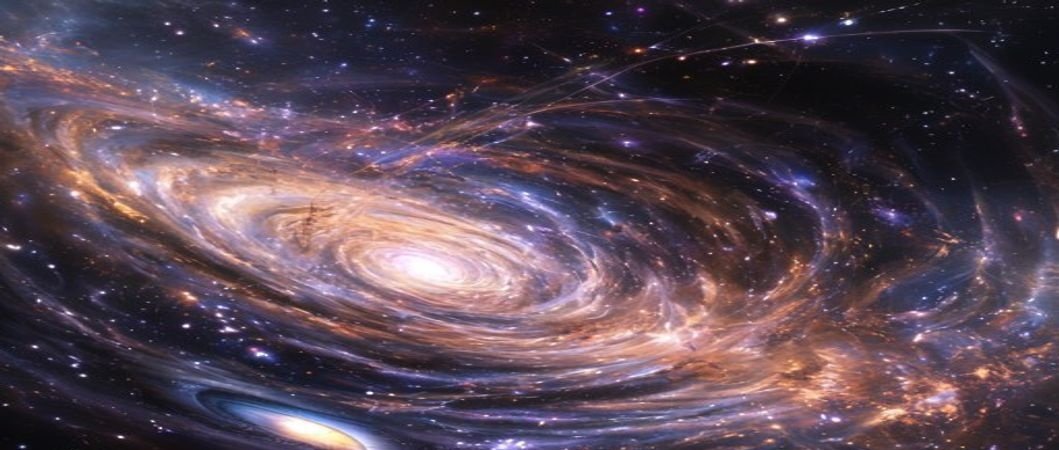
In a groundbreaking announcement that has left the scientific community abuzz, researchers from the University of Toronto, in collaboration with their counterparts at the Montreal Institute for Advanced Study, have unveiled a revolutionary spinoff of the iconic Big Bang Theory. The novel concept, dubbed “Nexus Universe,” seeks to redefine our understanding of the cosmos by proposing a multidimensional reality where the fabric of space-time is woven from an intricate tapestry of parallel universes.
According to Dr. Maria Rodriguez, lead researcher on the project, “Nexus Universe is an attempt to reconcile the long-standing discrepancies between general relativity and quantum mechanics. By positing the existence of parallel universes, we can create a framework that explains the mysterious phenomena that have puzzled scientists for decades.” The team’s research, published in the prestigious Journal of Modern Physics, presents a compelling case for the existence of these parallel universes, which they believe are accessible through wormholes and other exotic phenomena.
The implications of this theory are far-reaching, with potential applications in fields such as astrophysics, cosmology, and even quantum computing. As the scientific community continues to grapple with the mind-bending possibilities of Nexus Universe, one thing is certain: this groundbreaking spinoff of the Big Bang Theory is poised to revolutionize our understanding of the cosmos.